What is Geography?
Meaning, Definition, Branches, Importance, and Scope
Introduction
Geography is one of the oldest and most fascinating academic disciplines that helps us understand our planet and the relationships between people and their environments. Every day, we interact with geography, whether we use GPS navigation, monitor weather forecasts, study climate change, plan urban development, or explore different cultures around the world. Geography provides the knowledge and tools needed to understand these interactions and address many of the world's most pressing challenges.
The word "geography"often brings to mind maps, countries, mountains, and rivers. While these are important aspects of the discipline, geography is much broader. It examines not only the Earth's physical features but also human societies, economic activities, environmental processes, and the complex connections between them.
As globalization, climate change, rapid urbanization, and technological advancements continue to reshape our world, geography has become more relevant than ever before. Governments, researchers, businesses, environmental organizations, and policymakers rely on geographical knowledge to make informed decisions that affect millions of people.
This comprehensive guide explores the meaning of geography, its history, major branches, significance, scope, career opportunities, and its growing importance in the twenty first century.
What is Geography?
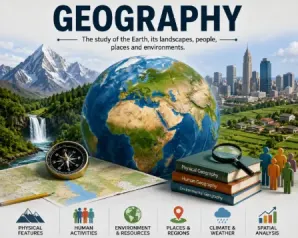
Geography is the scientific study of the Earth's surface, its physical characteristics, natural environments, human populations, and the interactions between people and their surroundings. It seeks to answer fundamental questions about where things are located, why they are located there, how they interact, and how these relationships change over time.
The term "Geography"originates from the Greek words Geo, meaning Earth, and Graphia, meaning writing or description. Therefore, geography literally means "the description of the Earth."
Unlike many other sciences that focus on a single subject, geography integrates knowledge from numerous disciplines, including geology, ecology, economics, sociology, anthropology, political science, environmental science, and information technology. This interdisciplinary nature makes geography uniquely positioned to study both natural and human systems simultaneously.
Modern geography investigates topics such as climate patterns, biodiversity, migration, urban development, natural hazards, resource management, transportation networks, population distribution, and sustainable development.
Historical Development of Geography
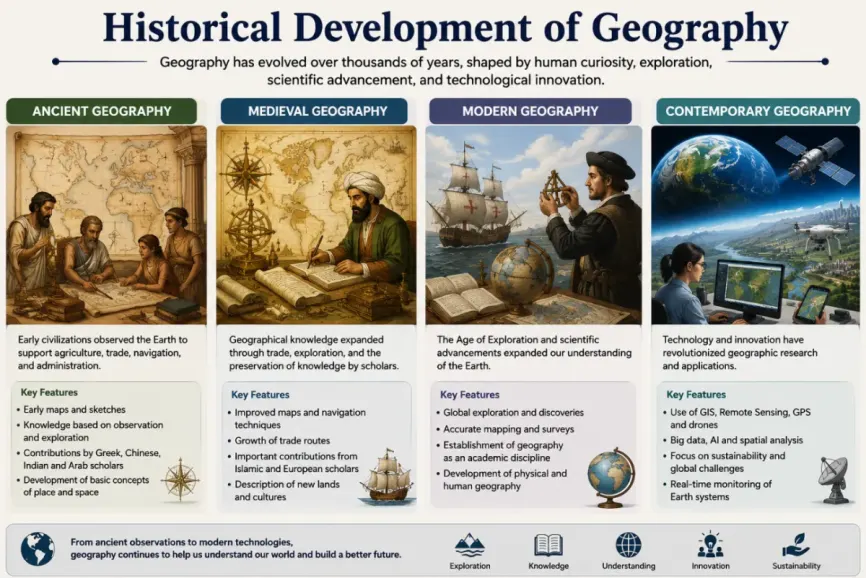
Ancient Geography
The roots of geography can be traced back thousands of years. Ancient civilizations in Egypt, Mesopotamia, India, China, and Greece developed early geographical knowledge to support agriculture, trade, navigation, and governance.
Greek scholars made significant contributions to the discipline. Early geographers attempted to measure the Earth's size, prepare maps, and explain natural phenomena based on observation and reasoning rather than mythology.
Medieval Geography
During the medieval period, geographical knowledge expanded through exploration, trade routes, and the preservation of scientific knowledge by scholars across Asia, the Middle East, and Europe. Improved navigation techniques and map making contributed to a better understanding of the world.
Modern Geography
The Age of Exploration dramatically expanded geographical knowledge. Explorers documented new continents, oceans, cultures, and ecosystems. During the nineteenth and twentieth centuries, geography evolved into a formal academic discipline with specialized branches focusing on both physical and human environments.
Contemporary Geography
Today, geography combines traditional fieldwork with advanced technologies such as Geographic Information Systems (GIS), satellite imagery, remote sensing, drones, artificial intelligence, and spatial data analysis. These technologies enable researchers to study the Earth with remarkable accuracy and solve complex environmental and social problems.
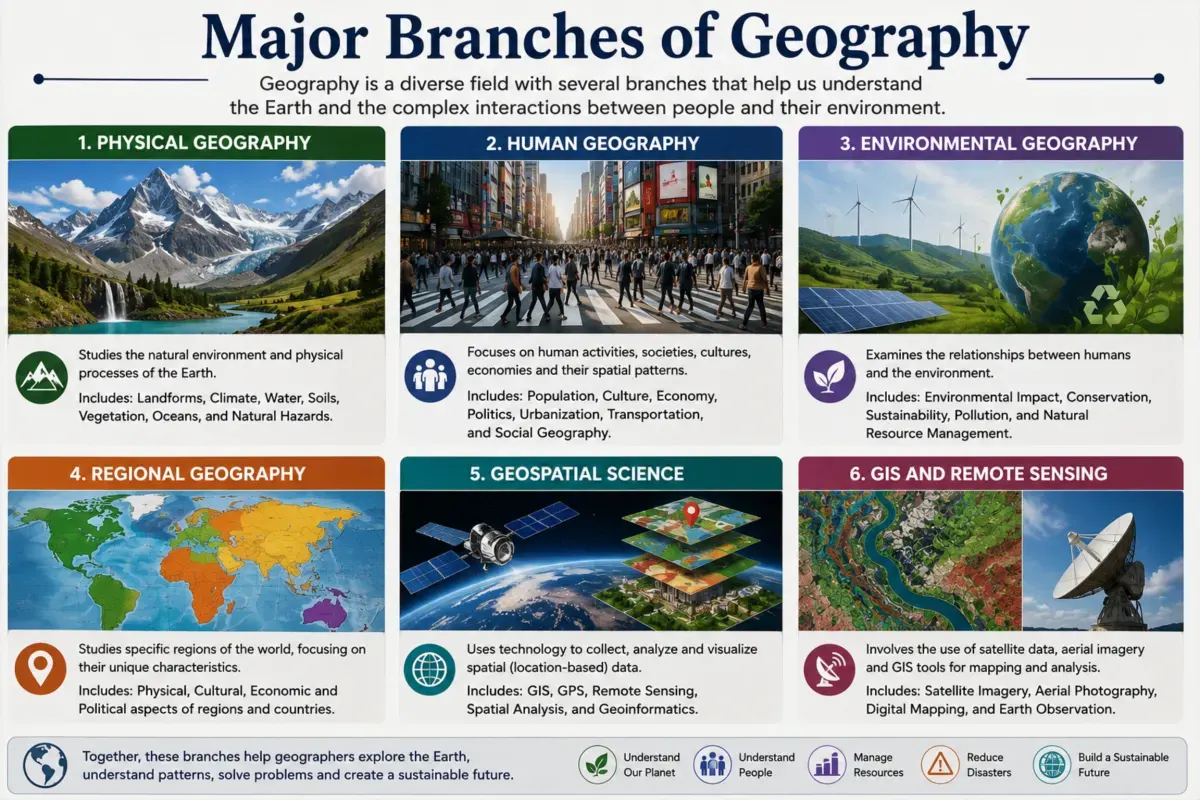
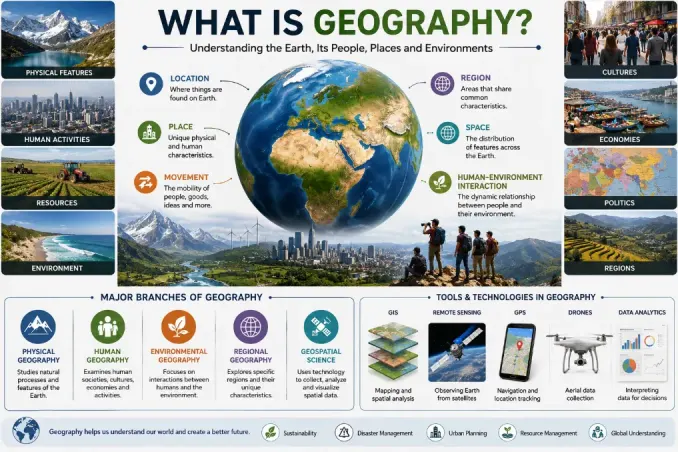
Major Branches of Geography
Physical Geography
Physical Geography examines the Earth's natural environment and physical processes. It focuses on landforms, climate, weather, soils, vegetation, water resources, and ecosystems.
Major areas include:
- Geomorphology
- Climatology
- Hydrology
- Oceanography
- Biogeography
- Glaciology
- Soil Geography
Physical geographers investigate earthquakes, volcanic activity, erosion, floods, droughts, climate systems, and ecosystem dynamics.
Human Geography
Human Geography studies people, cultures, societies, economies, and political systems within geographic space.
Key topics include:
- Population Geography
- Cultural Geography
- Economic Geography
- Political Geography
- Urban Geography
- Rural Geography
- Health Geography
- Tourism Geography
Human geographers analyze migration patterns, urbanization, globalization, demographic changes, transportation systems, and regional development.
Environmental Geography
Environmental Geography bridges physical and human geography by examining interactions between humans and the natural environment. Researchers study issues such as climate change, pollution, biodiversity conservation, deforestation, renewable energy, and sustainable resource management.
Regional Geography
Regional Geography focuses on specific regions of the world by integrating physical, cultural, economic, political, and environmental characteristics into a comprehensive understanding of individual places.
Geospatial Science
Geospatial Science uses advanced technologies to collect, manage, analyze, and visualize spatial information. This rapidly growing field supports decision making in urban planning, disaster management, agriculture, transportation, and environmental monitoring.
Fundamental Concepts in Geography
Several core concepts form the foundation of geographical study.
Location
Location identifies where a place exists on the Earth's surface. It may be expressed as an absolute location using coordinates or as a relative location based on nearby landmarks.
Place
Every location has unique physical and human characteristics that distinguish it from other places.
Space
Space examines how people and natural features are distributed across the Earth's surface and how they interact.
Movement
Movement studies the flow of people, goods, information, diseases, and ideas between places.
Human Environment Interaction
This concept explores how humans modify the environment and how environmental conditions influence human societies.
Region
Regions are areas sharing common characteristics such as climate, language, culture, economy, or political organization.
Importance of Geography
Geography plays an essential role in addressing global challenges and improving human well-being.
Climate Change
Geographers analyze changing weather patterns, rising temperatures, melting glaciers, sea level rise, and their impacts on ecosystems and communities.
Disaster Management
Geographical information helps predict natural hazards, prepare emergency response plans, identify vulnerable populations, and improve disaster resilience.
Urban Planning
Cities rely on geographical analysis for transportation systems, housing development, waste management, green infrastructure, and public services.
Agriculture
Farmers use geographical knowledge to select suitable crops, optimize irrigation, monitor soil conditions, and improve food security.
Environmental Conservation
Geographers contribute to biodiversity protection, ecosystem restoration, wildlife conservation, and sustainable resource management.
Public Health
Health geography examines disease distribution, healthcare accessibility, environmental health risks, and epidemic response strategies.
Transportation and Logistics
Modern transportation networks depend on geographical analysis for route optimization, infrastructure planning, and supply chain management.
Geography in Everyday Life
Many people use geography without realizing it.
Examples include:
- GPS navigation systems
- Digital maps
- Weather forecasting
- Air travel
- Shipping and logistics
- Tourism planning
- Real estate development
- Disaster warnings
- Environmental monitoring
- Mobile location services
These applications demonstrate how geography influences everyday decisions and improves quality of life.
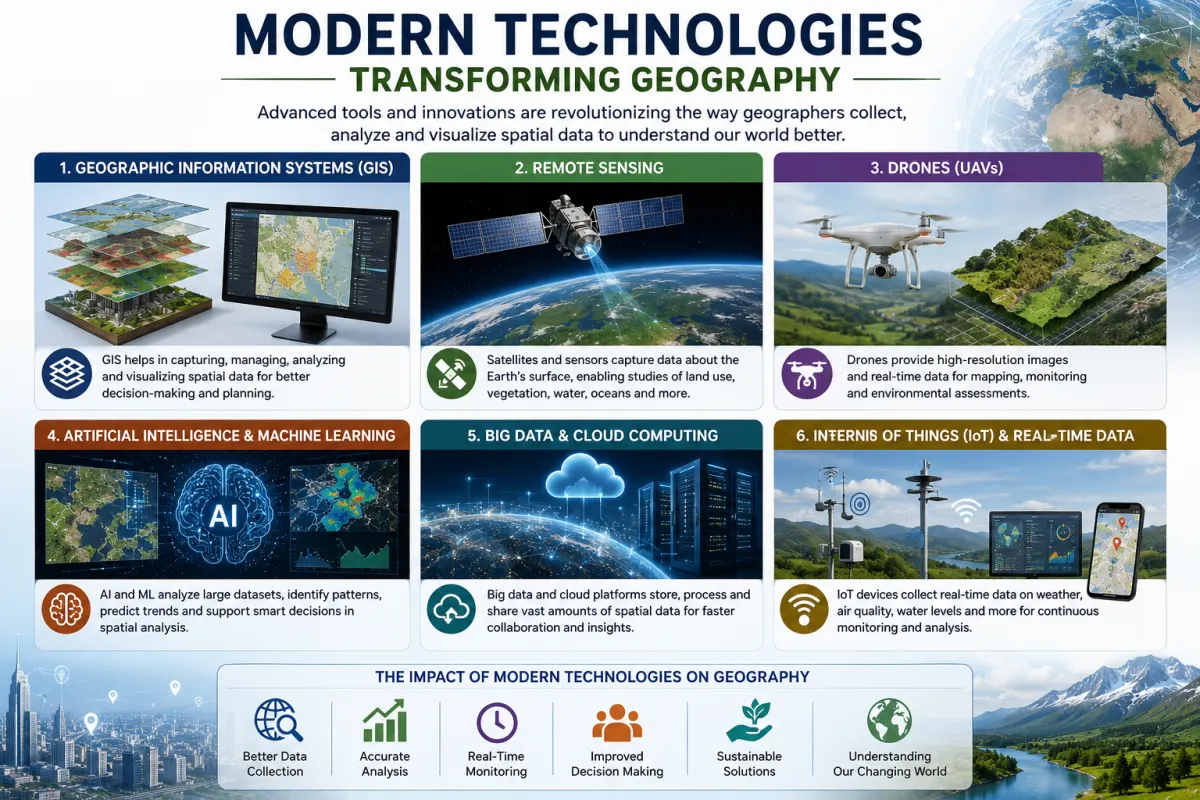
Modern Technologies Transforming Geography
Technological innovations have revolutionized geographical research.
Geographic Information Systems
GIS enables researchers to collect, manage, analyze, and visualize spatial data for informed decision making.
Remote Sensing
Satellites and aircraft capture detailed images of the Earth's surface, allowing scientists to monitor forests, agriculture, oceans, glaciers, and urban growth.
Artificial Intelligence
Artificial intelligence improves pattern recognition, predictive modeling, environmental monitoring, and automated image interpretation.
Drones
Unmanned aerial vehicles provide high resolution imagery for environmental surveys, infrastructure inspection, agriculture, and disaster assessment.
Big Data
Large spatial datasets enable researchers to understand population movements, transportation systems, climate trends, and urban dynamics.
Scope of Geography
The scope of geography extends across numerous academic, governmental, industrial, and environmental sectors.
Professional opportunities exist in:
- Environmental consulting
- Urban and regional planning
- GIS analysis
- Cartography
- Climate research
- Disaster management
- Natural resource management
- Transportation planning
- Tourism development
- Agriculture
- Public administration
- Education
- Research institutions
- International organizations
- Sustainable development projects
Because geography integrates natural and social sciences, graduates possess diverse analytical and problem solving skills valued by employers worldwide.
Career Opportunities in Geography
A degree in geography opens doors to many rewarding careers.
Popular professions include:
- Geographer
- GIS Analyst
- Cartographer
- Urban Planner
- Environmental Consultant
- Climate Scientist
- Hydrologist
- Disaster Management Specialist
- Remote Sensing Analyst
- Conservation Officer
- Transportation Planner
- Population Analyst
- Tourism Planner
- Research Scientist
- University Professor
- Government Policy Advisor
The increasing use of geospatial technologies has significantly expanded employment opportunities in both public and private sectors.
Why Geography Research Matters
Geographical research contributes directly to solving real world problems.
Researchers investigate:
- Climate adaptation strategies
- Sustainable cities
- Water resource management
- Renewable energy planning
- Biodiversity conservation
- Food security
- Environmental policy
- Migration patterns
- Disaster risk reduction
- Smart city development
Evidence based geographical research helps governments, international organizations, businesses, and communities make informed decisions that promote sustainable development.
Frequently Asked Questions
Is Geography a science?
Yes. Geography is a scientific discipline that combines physical, environmental, social, and spatial sciences to understand the Earth and human interactions.
What are the two major branches of Geography?
The two primary branches are Physical Geography and Human Geography.
Why is Geography important?
Geography helps us understand environmental processes, human societies, resource management, climate change, urban development, and global sustainability.
What skills do geographers use?
Geographers use analytical thinking, field observation, mapping, GIS, remote sensing, statistical analysis, data visualization, and research methods.
Can Geography help solve climate change?
Yes. Geographers study climate systems, assess environmental impacts, identify vulnerable regions, and develop adaptation and mitigation strategies.
What is GIS?
Geographic Information Systems are computer based technologies used to collect, analyze, manage, and visualize geographic information.
Conclusion
Geography is far more than the study of maps and places. It is a dynamic, interdisciplinary science that explores the relationships between the Earth's physical environment and human societies. By understanding these relationships, geography helps address some of humanity's greatest challenges, including climate change, natural disasters, environmental conservation, sustainable development, and urban growth.
In an increasingly interconnected world, geographical knowledge has become indispensable for researchers, educators, policymakers, businesses, and citizens alike. Advances in geospatial technologies, satellite imagery, artificial intelligence, and data science continue to expand the discipline's capabilities and societal impact.
Whether you are a student beginning your academic journey, a researcher seeking new discoveries, or a professional working to solve complex environmental and social issues, geography provides the knowledge, tools, and perspectives needed to understand our world and shape a more sustainable future.
As research continues to evolve, geography will remain at the forefront of scientific discovery, helping societies make informed decisions that balance human development with environmental stewardship. Through continued research, innovation, and collaboration, geography will continue to guide us toward a deeper understanding of our planet and our place within it.